We are looking for contacts, local community groups, interested individuals, routes into funding, places to exhibit, support, volunteers, publicity and people to network with in order to develop our projects.
Please contact us by emailing milesanddacombe@virginmedia.com.

Showing posts with label Snibston Museum. Show all posts

Wednesday, 16 March 2011

Myth Maps in Snibston; the story so far

Two fantastic walks have been completed to Snibston with family groups.  Thank you to all the Intrepid Explorers:  the Paines, the Bishops, the Petersons, the Rawsons and the Wheelers, for coming with me and bringing these walks alive!  Thanks also to Maurice and Esale for joining us, and to Snibston for making us so welcome.

Working drawing
My idea for Myth Maps is to look at how maps can tell tales about places and the meaning of places.  I am interested in how places build up layers of meaning over time, and those meanings can become intermingled, stories can be distorted through whispers or tales that are guessed at, overheard and passed on as fact.  Thus myths are created about the places that we inhabit and visit.

For Myth Maps I will map the walks that we took, not just the route we followed but the people who were with me (the Intrepid Explorers!), what they said, the tales we told, the dreams we dreamt, what happened on that particular walk on that particular day with that particular group.  The myths we made.


Walk 1 in February started at St Mary's Lane where Leicester Road meets Standard Hill.  Following footpaths across the fields, we looked for "treasure", listened to the sounds, and responded to the shapes of the land by running, jumping and climbing.


The walk took on a surreal, dreamlike quality, children finding delight in small, strange things they discovered, that seemed out of place and time.


They climbed trees and dug at the sides of fields, making up stories about magical lands and the King of the Forest.


My first map is called A Map of the Real and Surreal.

A Map of the Real and Surreal:  work in progress

Detail


Walk 2 started in Ravenstone at Woodstone School, a new school by new houses and next to a host of young trees still being planted into a new woodland.

Ravenstone to Snibston:  work in progress

Crossing through a newly made park full of mounds and mole hills, we then zigzagged through Ravenstone and into a playing field, down an old green lane and onto Church Lane, lined with 19th century houses.


Back across a field and up the steep hill where suddenly we saw Snibston below us, and the children raced down the hill to get there!


This walk seemed to take on the theme of different times overlapping and connecting, the old, new and the yet to come.  Each space we passed through had its own sound, its own atmosphere.  Some places had a sense that somebody had just been there - fresh animal tracks, the marks of footballers' boot studs.


An archeaological dig?

I have long had a feeling that Snibston as a place is where the past, present and future co-exist.  When I asked Jack, one of the boys on the second walk, where he thought the oldest place on our walk had been, he said "Snibston".  When I asked him where was the newest place, he thought for a while and then said "Snibston" again!  And he's exactly right!

The final walk is on Sunday, starting from Belvoirdale School in Coalville.

Wednesday, 22 December 2010

It's underneath our feet

A couple of things coalesced for me last week.  More maps, walking, networks...
 
On Monday I had a great time walking around Snibston and finding the footpaths that lead in and out of the site.  (There is now a Facebook page for the Transform project at Snibston.)


I also met with Nick at the museum, who was fantastic and spent lots of time showing me the maps of the mining seams and how they had been mapped from the mid 1800s until the 1980s, a period of almost 150 years of mining in the area.


Walking back through the fields I had this astonishing sense of the mapped tunnels beneath my feet, layer upon layer of seams cut through the earth, like the floors of a building inverted.


On the maps you can see that the mining seams are absolutely vast, stretching out underneath the town and neighbouring villages.


The maps themselves are beautiful, and incredibly complex.  Spiderwebs of tunnels that radiate out, the drawn lines mapped on top of other maps of the surface - the underneath layered on top, a very strange sense of parallel worlds that exist simultaneously in the same place.

Lines and networks stretch out everywhere, below and above ground.


A couple of days later I attended the New Research Trajectories event in Nottingham.  Bringing together research students from across the region, the event had a small audience who were also participants in exploring Nottingham on a walk, where we  encountered and took part in art presentations and happenings in unusual places.  (There is a great write-up and photos of the event on Heather Connelly's blog, scroll down to NEW RESEARCH TRAJECTORIES - Navigation in the City and Online Space event, Nottingham, 15th December.)

I met Jackie Calderwood who has done some interesting work on exploring spaces and walking.  She led us in an exercise on "Clean Language", asking each other questions in a set format which revealed deep levels of thought about our own research interests as well as producing extremely concise words or short poems.

We had to write our results on a sticker and also use colour in a grid pattern to express our research interests.  We then had to find a place to "disseminate" our stickers.

We visited the incredible Nottingham tunnels, we also experienced work in an old theatre and finished in a room above the Surface Gallery currently being used as a LAB for an artists' collective, where they served us an excellent minestrone soup!

My disseminated sticker ended up with the words "It's underneath your feet".  The colours on the grid represented the natural and the urban, reflecting how suddenly, by walking, you can cross from a predominantly urban area into a green stretch of land and countryside.  I placed my sticker on the bottom of a scaffolding pole, a place being refurbished which, for me, made it a transitional space.

Lots of connections with my walk at Snibston.  And a very fascinating day.

Sunday, 28 November 2010

New commissions and a little Coalville history

Carole and I have both got ourselves new commissions!

I will be working on my Myth Maps project at Snibston Colliery in Coalville.  Carole will be working on a project for Leicestershire Museums, which she has called The Held in the Hand Hoard.  I'll let her tell you more about that herself.

I am particularly pleased with my Myth Maps project as it draws together a number of things I have been thinking about, things I have been blogging about here and it links with this project.

Leicester & Swannington rail ticket
A little history...

The colliery at Coalville, as I blogged before (see Preservation and Persistence), includes the wonderful historic railway track.  A line was put down by George and Robert Stephenson for the Leicester to Swannington Railway (L&S), one of the first of England's railways, opened in 1832 to bring coal from pits in west Leicestershire (Whitwick, Ibstock and Bagworth) to Leicester.

The Leicester & Swannington Rail Line
Whitwick Colliery, 1926
George Stephenson was known as the "father of railways", having built the first public railway using steam locomotion (the Stockton and Darlington Railway).  His son, Robert,  worked with his father and developed the famous "Rocket".  Robert was the engineer for the Swannington line and George opened the Snibston colliery the following year.

Midland Railway Station in Coalville, 1889
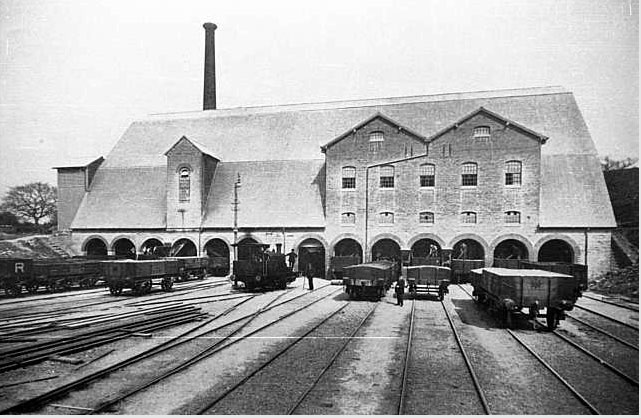
Sidings at Bardon Hill quarry
So the history of Snibston colliery and the railways are intertwined.  It was the success of the railways to speed up the transportation of coal that enabled the coal industry from west Leicestershire to thrive, which enabled the opening of the pit at Snibston.

Coalville East Station
Thanks to the Coalville Heritage Society website for these pictures.  Also, they have a wonderful sound archive of Coalville dialects, called Covill Tork - click on the link if you want to find out what the following mean (and make sure you have your speakers on!):

Woreeawreet?
Ayoopmissusenthemassteeratom?

Covill Tork 

Friday, 24 September 2010

preservation and persistence

I have been invited to make a proposal for some work at Snibston Museum in Coalville, so today I went to the site to look at the possibilities and meet the other artists.  What I found follows nicely on from Carole's last blog, Erosion.


The site includes the old colliery, the massive structures of the pit heads still there, looking both immense and fragile simultaneously as parts rust away.  There is a continuous battle to keep these monuments from crumbling away.


Here I stumble across another railway line.  The old rail tracks that used to bring coal to the site from other areas around Coalville.  The track runs right into the town centre from here.


I love the sense of connectedness that these converging lines express.  These particular lines are especially significant to me as they are not just relics but are a present and changing site.  The railway tracks themselves are designated as a Site of Special Scientific Interest, which means they cannot be touched, developed or changed by people.  However, the very fact that they are left untrampled by man means that nature is now reclaiming the tracks for themselves.  Apparently several important species of fauna are now found there.   We spotted the most beautiful bright yellow evening primroses growing out of the lines.


Several other parts of the site show nature squeezing itself back into every nook and cranny of the preserved and untouched.  Peering through dusty windows in old store houses, now locked up, you can see shrubs pushing their way through and grabbing any sunlight available.  I love the persistence of nature.  It grows despite us.


Rust and lichen reclaim our neglected iron structures and turn them into their own art works.  Historical sites such as these are not frozen in time at all, but sites of the most beautiful acts of growth and weathering beyond our control or prediction.