We are looking for contacts, local community groups, interested individuals, routes into funding, places to exhibit, support, volunteers, publicity and people to network with in order to develop our projects.
Please contact us by emailing milesanddacombe@virginmedia.com.

Showing posts with label colliery. Show all posts

Sunday, 28 November 2010

New commissions and a little Coalville history

Carole and I have both got ourselves new commissions!

I will be working on my Myth Maps project at Snibston Colliery in Coalville.  Carole will be working on a project for Leicestershire Museums, which she has called The Held in the Hand Hoard.  I'll let her tell you more about that herself.

I am particularly pleased with my Myth Maps project as it draws together a number of things I have been thinking about, things I have been blogging about here and it links with this project.

Leicester & Swannington rail ticket
A little history...

The colliery at Coalville, as I blogged before (see Preservation and Persistence), includes the wonderful historic railway track.  A line was put down by George and Robert Stephenson for the Leicester to Swannington Railway (L&S), one of the first of England's railways, opened in 1832 to bring coal from pits in west Leicestershire (Whitwick, Ibstock and Bagworth) to Leicester.

The Leicester & Swannington Rail Line
Whitwick Colliery, 1926
George Stephenson was known as the "father of railways", having built the first public railway using steam locomotion (the Stockton and Darlington Railway).  His son, Robert,  worked with his father and developed the famous "Rocket".  Robert was the engineer for the Swannington line and George opened the Snibston colliery the following year.

Midland Railway Station in Coalville, 1889
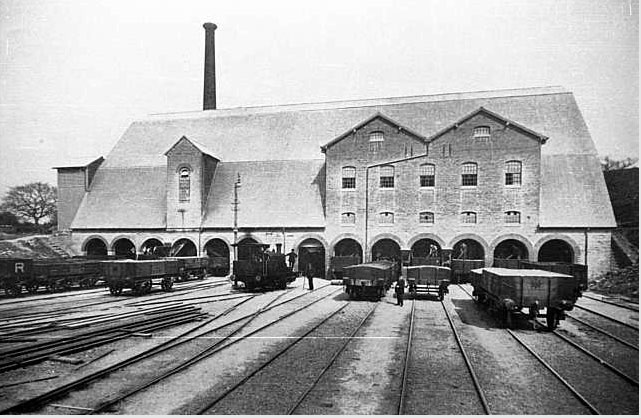
Sidings at Bardon Hill quarry
So the history of Snibston colliery and the railways are intertwined.  It was the success of the railways to speed up the transportation of coal that enabled the coal industry from west Leicestershire to thrive, which enabled the opening of the pit at Snibston.

Coalville East Station
Thanks to the Coalville Heritage Society website for these pictures.  Also, they have a wonderful sound archive of Coalville dialects, called Covill Tork - click on the link if you want to find out what the following mean (and make sure you have your speakers on!):

Woreeawreet?
Ayoopmissusenthemassteeratom?

Covill Tork 

Friday, 24 September 2010

preservation and persistence

I have been invited to make a proposal for some work at Snibston Museum in Coalville, so today I went to the site to look at the possibilities and meet the other artists.  What I found follows nicely on from Carole's last blog, Erosion.


The site includes the old colliery, the massive structures of the pit heads still there, looking both immense and fragile simultaneously as parts rust away.  There is a continuous battle to keep these monuments from crumbling away.


Here I stumble across another railway line.  The old rail tracks that used to bring coal to the site from other areas around Coalville.  The track runs right into the town centre from here.


I love the sense of connectedness that these converging lines express.  These particular lines are especially significant to me as they are not just relics but are a present and changing site.  The railway tracks themselves are designated as a Site of Special Scientific Interest, which means they cannot be touched, developed or changed by people.  However, the very fact that they are left untrampled by man means that nature is now reclaiming the tracks for themselves.  Apparently several important species of fauna are now found there.   We spotted the most beautiful bright yellow evening primroses growing out of the lines.


Several other parts of the site show nature squeezing itself back into every nook and cranny of the preserved and untouched.  Peering through dusty windows in old store houses, now locked up, you can see shrubs pushing their way through and grabbing any sunlight available.  I love the persistence of nature.  It grows despite us.


Rust and lichen reclaim our neglected iron structures and turn them into their own art works.  Historical sites such as these are not frozen in time at all, but sites of the most beautiful acts of growth and weathering beyond our control or prediction.