We are looking for contacts, local community groups, interested individuals, routes into funding, places to exhibit, support, volunteers, publicity and people to network with in order to develop our projects.
Please contact us by emailing milesanddacombe@virginmedia.com.

Showing posts with label industrial heritage. Show all posts

Sunday, 28 November 2010

New commissions and a little Coalville history

Carole and I have both got ourselves new commissions!

I will be working on my Myth Maps project at Snibston Colliery in Coalville.  Carole will be working on a project for Leicestershire Museums, which she has called The Held in the Hand Hoard.  I'll let her tell you more about that herself.

I am particularly pleased with my Myth Maps project as it draws together a number of things I have been thinking about, things I have been blogging about here and it links with this project.

Leicester & Swannington rail ticket
A little history...

The colliery at Coalville, as I blogged before (see Preservation and Persistence), includes the wonderful historic railway track.  A line was put down by George and Robert Stephenson for the Leicester to Swannington Railway (L&S), one of the first of England's railways, opened in 1832 to bring coal from pits in west Leicestershire (Whitwick, Ibstock and Bagworth) to Leicester.

The Leicester & Swannington Rail Line
Whitwick Colliery, 1926
George Stephenson was known as the "father of railways", having built the first public railway using steam locomotion (the Stockton and Darlington Railway).  His son, Robert,  worked with his father and developed the famous "Rocket".  Robert was the engineer for the Swannington line and George opened the Snibston colliery the following year.

Midland Railway Station in Coalville, 1889
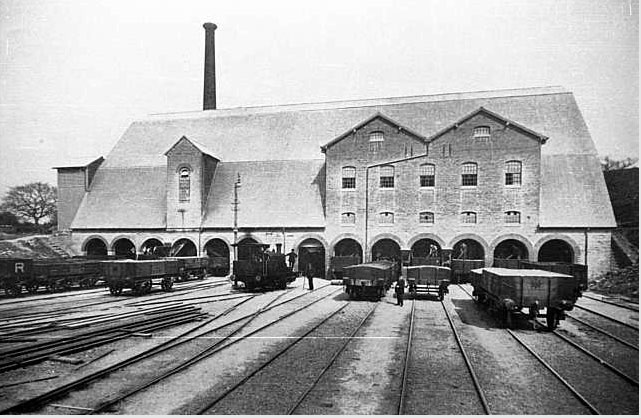
Sidings at Bardon Hill quarry
So the history of Snibston colliery and the railways are intertwined.  It was the success of the railways to speed up the transportation of coal that enabled the coal industry from west Leicestershire to thrive, which enabled the opening of the pit at Snibston.

Coalville East Station
Thanks to the Coalville Heritage Society website for these pictures.  Also, they have a wonderful sound archive of Coalville dialects, called Covill Tork - click on the link if you want to find out what the following mean (and make sure you have your speakers on!):

Woreeawreet?
Ayoopmissusenthemassteeratom?

Covill Tork 

Friday, 30 July 2010

THOUGHTS FROM THE WAITING ROOM


I feel as though I am in the Waiting Room – in the time before activity or before our proposed journeys can begin, I am pacing round the room, looking out, watching the clock, ready for the off. There are walls and windows between me, and where I hope to be. There is excitement, a sitting on the edge of my seat feeling, so many things may yet be possible.

The Waiting Room itself could be a place of creative activity, convention dictates that the passenger must sit and wait, but other activities could take place in this ‘waiting’ space. It could also be seen as a space waiting for something to happen. I can see all the possible activities that could take place but I must sit on my hands for the time being, and wait. In this time of waiting, I’m taking the opportunity to make other sorts of journeys on different, pre-existing networks.


Out on winding country roads hardly a car wide navigating by ordinance survey map learning to look for landmarks – pylons cutting across the road and changing direction – seeing first the diagram on a map before the pylons appear in reality. Very little traffic, apart from the inevitable, impatient 4 by 4.


Cradled inside an old landscape of gnarled trees and bountiful fields, villages connected by many small roads that crisscross and intersect each other. Small wonders that can punctuate the day, a well- stocked gift shop, a recycled wool blanket at a bargain price, the impromptu cream tea in a tree shrouded car park.

Striding out on tow paths beside canals, walking along networks and systems, which were designed to transport all kinds of goods, routes cut into the landscape, engineered and manmade.

As with trains, these walks can afford a glimpse into the gardens and backyards of others, some well tended, some a blank canvass, others chaotic and uncared for.

Passing alongside once thriving industrial buildings, the landscape bearing traces of change, decay, renewal, the ghosts of problem solving, remnants of the places where networking systems met and moved on, leaving one mode defunct once a new form of transportation took it’s place.